
Global Unified Reuse Symbol Unveiled, Oregon Leads Pilot Application
The PR3 Global Reuse Alliance recently introduced a globally unified reuse symbol, based on strict standards, designed to distinguish reusable packaging from ordinary recyclable packaging. As a pioneer in the reuse field, multiple businesses in the Portland, Oregon area, including Bold Reuse and Revino, have already adopted this symbol.
Editor's note: This article is the first in a series focusing on efforts by public and private sectors in the Portland, Oregon area to scale up reusable packaging systems.
PORTLAND, Ore. — Since its debut in 1970, the imperfect but ubiquitous "chasing arrows" symbol has become the icon of recycling. Now, the reuse industry is trying to achieve similar instant recognition with a new symbol launched globally last week.
U.S. companies are among the first to commit to using the symbol, especially those in the Portland area, a region with a reputation as a pioneer in the reuse field.
PR3: The Global Alliance to Advance Reuse selected the new symbol from 236 submissions across 29 countries, with the design from Colombian creative agency Epigrama Studios winning out. PR3 offers versions both with and without the word "reuse."

"This is the opportunity to let the world know there is a better choice," said Amy Larkin, co-founder of PR3, adding that the new symbol is both directional and inspirational.
According to PR3, this universal reuse symbol differs from the vague recycling claims commonly seen on packaging today because it is tied to specific criteria in PR3's Symbol and Label Standard, which is soon to be published by the American National Standards Institute.
Under PR3's rules, the symbol can only be used on packaging and infrastructure operating within systems that include collection, transportation, sorting, cleaning, and reuse processes. It will be used on reusable packaging such as cleaning products, takeout food, cups, and beverage bottles, as well as on infrastructure like collection bins, logistics vehicles, and cleaning facilities in both closed-loop and open-loop systems.
Larkin said these standards are expected to prevent "greenwashing." She explained that if companies misuse the symbol, trademark rights give PR3 the option to intervene and take enforcement action.
Larkin noted that participating in reuse systems has commercial value because reusable products save on inventory and waste disposal costs. This is especially true in the current environment where tariffs and the war with Iran are driving up material prices and disrupting supply chains. "This is part of a resilience strategy to protect product supply and price stability."
Larkin also said the symbol helps drive the scaling of reuse systems. "You can't scale reuse without a symbol. People have to understand this is different."
Scaling is a key theme for several reusable packaging systems in the Pacific Northwest, especially in the Portland area.
"Oregon is a hotbed of efficient reuse businesses," Larkin said. "There are very strong entrepreneurs locally who are taking full advantage of this opportunity. Moda Center is the first sports venue in the country to fully implement a venue-wide reuse program."
Portland-based Bold Reuse operates the reusable cup program at that professional sports venue. The company partnered with the Portland Trail Blazers on a cup pilot project, which became a permanent venue-wide program in September 2024.

Bold Reuse is also one of the early adopters of the new reuse symbol. Its production partners have begun manufacturing reusable cups with the symbol, and the company is gradually introducing these cups into its closed-loop reuse system.
"We've already launched the new label and cups in Kansas City and Michigan," said Heather Watkins, co-founder and chief revenue officer of Bold Reuse. "It's not currently a requirement on packaging, but we are adding the symbol to all our products."
Watkins is among those supporting the symbol, and she expects it will be clearer for consumers and less controversial than the "chasing arrows," which has been used on products that are not actually recyclable in most U.S. curbside recycling systems. California's SB 343 is driving attention to label truthfulness, but sources expect the law will not pose a problem for the reuse symbol.
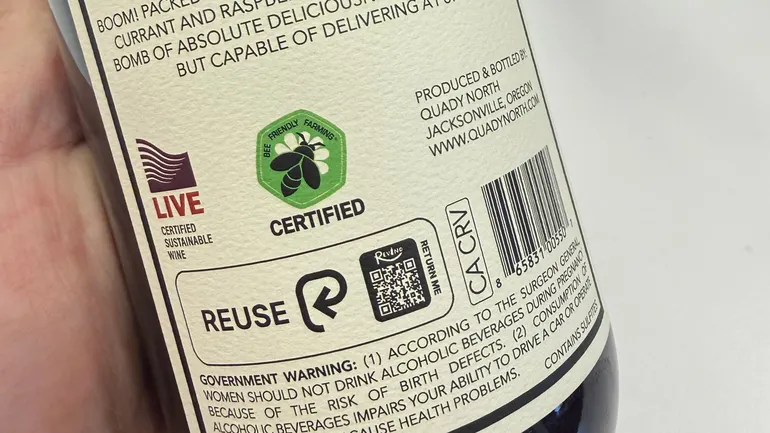
Oregon-based Revino, a reusable wine bottle company, is an early adopter of the new symbol in an open-loop system.
"Now everyone sees the recycling symbol and thinks 'oh, this is recyclable.' We want the same for reuse," said Adam Rack, co-founder of Revino. "Whether you're in Canada, Asia, or Germany, we want people to see this symbol and know where to return the item."
Revino ultimately plans to emboss the symbol in the punt of the bottle. Rack said this is the most cost-effective placement in the mold because a new mold set costs up to $90,000. "The punt section is much cheaper. We can easily swap out mold parts to incorporate the new design."
At an event held June 4 at the Portland Art Museum, Rack showcased the various symbols and messages Revino's refillable bottles used before introducing the universal design. In addition to a QR code with information, the label featured an infinity symbol as a "placeholder for the reuse symbol," Rack said. The bottle also had the word "refillable" embossed on it.

"We chose the word 'refillable.' Other groups reached consensus around 'reuse' or 'refill,' but our molds were already in production," he said. "This is probably one of the differences from entering the market a bit earlier."
He expects the new universal reuse symbol will reduce consumer confusion, but reaching critical scale and instant recognition still requires effort—especially for open-loop systems where packaging is taken off-site and consumers must return it to drop-off points.
"Open-loop systems will be harder because we have to think about interoperability between these systems," Rack said. "But having a symbol that reflects 'reuse' can hopefully be a signal that makes it easier for people to accept and participate."
PR3 expects the use of the symbol to expand into new product categories. Additionally, Larkin envisions more influencers and brand ambassadors will champion the reuse cause, and the new symbol will further raise awareness.
"I think it represents the next wave of global commerce, with less waste and making single-use a thing of the past," Larkin said.