
Oregon Packaging EPR First-Year Data Review: Key Indicators Six Months After Program Launch
Circular Action Alliance (CAA) releases its first annual report detailing the implementation of Oregon's packaging Extended Producer Responsibility (EPR) program—the first of its kind in U.S. history. The report covers data from just six months following the July 1, 2025 launch, with CAA positioning 2025 as a "building year" aimed at completing full system implementation by the end of 2027. Meanwhile, the program faces legal challenges: a lawsuit filed by the National Wholesale Distributors Association is set for trial in Oregon next week, and manufacturer Lollicup USA has also filed a class-action lawsuit against state Department of Environmental Quality Director Leah Feldon. Below are the key figures disclosed by CAA for the first six months.
Circular Action Alliance (CAA) has released its first annual report detailing the implementation of Oregon's packaging producer responsibility (EPR) program — the first program of its kind to formally operate in U.S. history. The report covers only the first six months after the program's launch, which took effect on July 1, 2025.
CAA has positioned 2025 as a "building year," with the producer responsibility organization planning to complete full system implementation by the end of 2027. While CAA highlights the early impact of EPR funding, the program's future faces multiple challenges: the National Association of Wholesaler-Distributors argues that packaging EPR laws are unconstitutional, with a related trial scheduled for next week in Oregon; additionally, manufacturer Lollicup USA recently filed a class-action lawsuit against Leah Feldon, Director of the Oregon Department of Environmental Quality.
Below are some key data points CAA disclosed from the first six months of the Oregon program.
Collection of Covered Materials
Oregon's Plastic Pollution and Recycling Modernization Act aims to expand collection through increased curbside collection and drop-off site services. For drop-off-based collection, CAA states that the 2026 reporting year will serve as the baseline year for calculating utilization and collection rates.

Producers reported selling nearly 410,000 tons into Oregon
Key collection data points include:
- 144,771 tons: total materials collected through mixed collection, drop-off sites, and other applicable programs.
- 18,888 tons: glass collected and recycled through curbside incentive programs. CAA calculates an implied collection rate of 49%, exceeding the state's 45% glass recycling target.
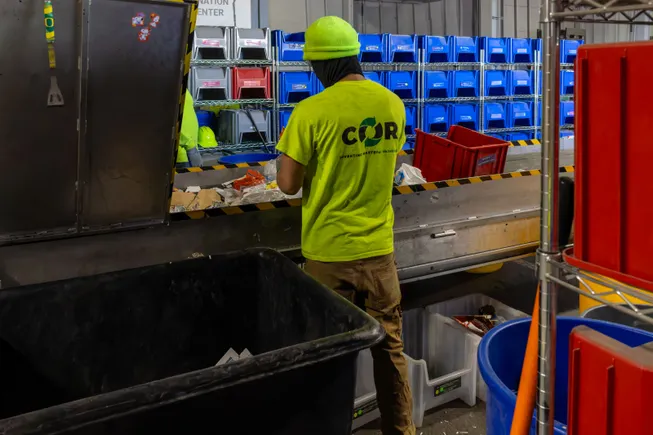
- 24.73%: overall contamination rate of sampled materials. This figure is based on 554 sample audits, most representing the Portland area, which began in September and were conducted by the newly established Contamination Audit Center. Major contaminants include composite materials, fines, glass, coated paperboard, and bagged trash.
Responsible End Markets
Oregon law emphasizes sending materials to Responsible End Markets (REM). These requirements aim to ensure materials are recycled in a transparent, traceable manner while minimizing environmental and public health risks. CAA is developing timelines and documentation requirements to phase in Oregon's REM requirements. Meanwhile, CAA is also advancing a global REM standard.
- $56,486: amount spent in 2025 on responsible end market development and verification.
- 44: number of self-declared end markets to which MRFs and CAA Oregon sent materials during the first six months of the program, including 24 recyclers, 16 brokers, and 4 disposal sites. Self-declared end markets commit to following REM principles, which is the first step toward becoming an REM.
- 95.97%: percentage of materials delivered to self-declared end markets during the first six months of the program.
System Fees
Oregon's packaging EPR program is the first in the U.S. funded by producer fees. CAA states that 2025 program costs were lower than initially expected, "due to the implementation timeline — not a reduction in scope — with major investments planned for 2026 and 2027 as contracts and procurement progress."

- 2,909: number of participating producers.
- $167.9 million: revenue generated from producer fees.
- $56.5 million: actual program spending during the period, including startup costs.
- $111.4 million: cumulative reserves at the end of the period.
Recycling Investments
Where is the funding being reinvested? Starting in 2025, expenditures include new collection tools and recycling centers. CAA continues to advance in 2026: The Dalles is an Oregon community receiving larger capacity recycling bins to collect a wider variety of materials. Elsewhere, CAA funded new trucks aimed at supporting recycling service expansion as residents begin recycling more types of materials.
Looking ahead, CAA aims to establish 144 recycling centers by the end of 2027, providing convenient drop-off points for "hard-to-sort materials" that cannot go in curbside recycling bins but can still be recycled in the state, including items such as plastic bags, lids, plastic buckets, shredded paper, and aluminum foil.

- 20: number of RecycleOn centers as of December 2025.
- 42,297: number of recycling containers ordered.
- 12: number of trucks ordered.
- $16.2 million: amount CAA paid to 8 MRFs in processor commodity risk fees. This funding is intended to support MRF investments in equipment and infrastructure and help MRFs manage commodity value fluctuations.
- $6.3 million: amount CAA spent on contamination reduction projects. Local governments can receive up to $3 per resident per fiscal year to implement projects that reduce recycling contamination.