
Half-pint carton shortage may last until end of school year, unbranded packaging eases supply pressure
The widespread packaging shortage of 2023 has extended into the new year. Domestic dairies, schools, and others continue to be plagued by a half-pint carton shortage that has lasted for months. Although predictions suggest the issue may not be resolved before the end of the school year, some mitigation measures are already in place. Sources indicate that Pactiv Evergreen's closure of its Olmsted Falls, Ohio, plant last year may be a potential cause of the supply disruption.
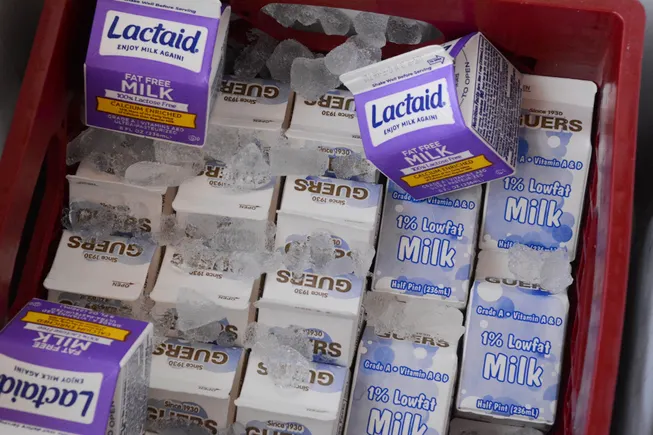
The widespread packaging shortage that affected 2023 is continuing into the new year. Domestic dairy plants, schools, and other institutions are still grappling with a shortage of half-pint paper cartons that has persisted for months.
Although predictions suggest the issue may not be resolved before the end of the school year, some assistance has already arrived. Some sources indicate that one potential cause of the supply disruption could be Pactiv Evergreen's decision last year to close its processing plant in Olmsted Falls, Ohio, which produced 8-ounce cartons.
While some observers initially speculated that a cardboard shortage caused the supply chain disruption, this theory has largely been set aside. It is understood that the closed Olmsted Falls plant produced a significant volume of the nation's 8-ounce cartons, which are especially used by dairies serving schools, healthcare facilities, and other institutions. The shortage has also affected other beverage suppliers using this container size, such as juice or iced tea.
"That Ohio plant, a lot of our product came from there. When it closed, things got bad," said Scott Stoner, Vice President of Operations at Cream-O-Land Dairy in New Jersey. "We are still in a shortage."
A former employee who worked at the Olmsted Falls plant (who requested anonymity because they were not authorized to speak publicly) stated that the disruption in the 8-ounce carton supply chain is directly linked to the plant's closure. The employee, who held various positions on the carton production lines until last year, estimated based on their knowledge of production volumes on each line that Olmsted Falls produced approximately 18 million 8-ounce cartons per week.
Around the time of Olmsted Falls' closure in June, employees at other Pactiv Evergreen carton manufacturing plants "were already struggling," the former employee said based on conversations with workers at other facilities, possibly due to internal issues like labor or hiring. "Some people were already working six days a week, some even seven," the former employee said.
Pactiv Evergreen did not respond to inquiries about the Olmsted Falls plant and the reasons for the carton supply disruption.
Saying goodbye to branded packaging
Pactiv Evergreen stated in an email on Wednesday that it has increased carton production to maximum capacity. Although shipments are higher than during the peak of the shortage, they still haven't met initial demand, Stoner confirmed. Additionally, there's a catch with the extra 8-ounce cartons: they are generic, without any branding.
"They're shipping these all over the country. It's the same container for all of us. No logos of ours," he said. "Right now, 1% chocolate milk and 1% white milk are shipping in generic packaging. They're also adding a nonfat half-pint that will also be generic, which we just signed off on this week."

Pactiv Evergreen stated in its announcement that the generic containers are part of its response to "simplify supply chain complexity." The company also said it continues to produce cartons at maximum capacity even during "school breaks, so customers can build inventory," and thanked customers for their patience.
"We will continue to work with those closest to milk consumption—dairies and dairy processors directly serving schools—to support forecast accuracy and encourage them to build inventory over the summer to prevent this from happening again," the statement said.
The generic cartons have provided Cream-O-Land with its first relief since encountering supply issues in September and beginning to explore solutions. Stoner had considered sourcing from domestic and international packaging suppliers, putting half-pint milk into larger containers, using large milk dispensers instead of cartons, and allocating supplies within its service area (most of the East Coast and parts of the Caribbean). These methods proved labor-intensive and costly.
Cream-O-Land's multi-year exclusive supply contract with Pactiv Evergreen expired in December. Cream-O-Land was told that due to carton supply uncertainty, the packaging company did not request renewal or negotiation, but would instead operate on an as-needed basis indefinitely. Additionally, "they lowered our price, which is incredible," Stoner said.
While no other single company can fully supply the volume of half-pints Cream-O-Land needs to fill the gap left by Pactiv Evergreen, the dairy has had successful discussions with several companies. Elopak, in particular, has been helpful in providing additional cartons, which arrived at Cream-O-Land this week, Stoner said. Other packaging suppliers are testing the dairy's products in their packaging, and Cream-O-Land hopes to add more suppliers by the end of the month—though shipping delays are common across suppliers.
"We're surviving... we're running week to week," he said. "In December, we were running day to day. In the last week of December, maybe the last two weeks, we finally got enough packaging to stop running day to day."
Tetra Pak is another major domestic carton producer, and since the shortage began last year, it has received many requests for assistance—from both existing and potential customers. Seth Teply, President and CEO of Tetra Pak US and Canada, said via email on Wednesday that the company has limited capacity to take on new customers.
"Our existing customer base saw increased demand for gable-top cartons in 2023. Therefore, we have been focused on fulfilling contractual orders for existing customers," Teply said.
He noted that demand for Tetra Pak's half-pint gable-top cartons remains high. Additionally, the company is seeing growing interest in its aseptic milk cartons.
Schools have been particularly affected by the 8-ounce carton supply issue because they must offer milk at breakfast and lunch to meet federal requirements, and the industry heavily uses half-pints. Currently, "the situation is still evolving," but school milk shortages—caused entirely by packaging rather than milk supply—appear to be "sporadic and localized," said Matt Herrick, Senior Vice President of Public Affairs and Communications at the International Dairy Foods Association. "Therefore, we are advising everyone who contacts us not to panic."
He said Pactiv Evergreen's generic cartons have eased supply tensions somewhat in recent weeks.
"This has helped processors at least keep enough inventory to fulfill immediate orders. However, lead times are still very tight," Herrick said. "We are asking processors to report any ongoing disruptions so we can help triage the situation as quickly as possible while seeking short-term solutions until the shortage eventually eases."
Plant issues
Pactiv Evergreen announced restructuring actions on March 6, 2023, including closing the Olmsted Falls processing plant and the pulp and paper mill in Canton, North Carolina, both of which were largely shut down in June. A total of about 1,300 jobs were cut, with approximately 160 of those in Olmsted Falls. The company also said it would explore "strategic alternatives" for its plant in Pine Bluffs, Arkansas, and its extrusion plant in Waynesville, North Carolina, but has not yet announced specific plans.
According to the former Olmsted Falls employee, Pactiv Evergreen told workers the closure was due to declining demand. But some employees doubted this reasoning, especially when carton disruptions emerged months later, and they questioned whether union relations issues led to the closure, the source said.
The United Steelworkers union represented Olmsted Falls, Canton, and several other Pactiv Evergreen plants, which bargained jointly under the same master contract, according to the former employee. In late 2022, they rejected the most recent contract offer, marking the first time in at least 50 years that Olmsted Falls and Canton had done so, the former employee said. Multiple rounds of negotiations followed, with Pactiv Evergreen reaching an agreement with Olmsted Falls, but not with Canton by the time the closure was announced in March 2023, the former employee said. The USW did not respond to a request for comment on the timing of contract negotiations by press time.
Anonymous public comments on Glassdoor, allegedly written by Olmsted Falls and Canton employees, also mention the plant closures, questioning possible union issues and whether Pactiv Evergreen closed the plants before employees went on strike. Additionally, a "retaliation" case was filed against the Canton plant with the National Labor Relations Board in 2022, which investigates complaints of unfair labor practices or violations of workers' organizing rights.
Pactiv Evergreen did not respond to requests for comment on labor issues.
Addressing the fluid situation
Pactiv Evergreen issued a statement to CNN in November, saying it faced "significantly higher-than-expected demand," implying this led to the shortage. But some question whether that explanation holds up.
"Demand is exactly the same," speculated Stoner of Cream-O-Land. "I think someone messed up."
Although the generic half-pints provide some relief, Stoner doesn't expect the supply issue to be fully resolved anytime soon.
"Obviously, it won't be back to normal this school year," he said. "Maybe next school year. Maybe."
This aligns with Tetra Pak's view on when a full resolution might occur.
"We expect demand to remain high for the rest of the school year, and we have continued to allocate overtime shifts to increase output," Teply said.
But Herrick of IDFA is more optimistic: "All indications continue to suggest that supply challenges will ease in late winter or early spring, provided there are no further disruptions, unexpected supply shocks, or other unforeseen events."
The U.S. Department of Agriculture's Food and Nutrition Service highlighted the carton shortage in an October 25 memo, noting that some schools nationwide were struggling to obtain milk due to packaging supply chain issues. Members of Congress—including Senate Majority Leader Chuck Schumer (D-NY) and Rep. Mark Molinaro (R-NY)—have called on USDA to take action regarding the carton and milk backlog.
A USDA spokesperson confirmed via email on Thursday that the agency's Food and Nutrition Service continues to assist school districts experiencing milk supply disruptions due to carton issues. FNS has communicated with representatives of half-pint milk carton suppliers to help find solutions, the spokesperson said, and "will continue to use available authorities and resources to address this situation."
FNS's latest guidance was issued on October 25, reiterating that school lunch program operators should meet federal milk requirements "to the extent possible." During "emergency periods," operators may use alternative forms of milk or waive milk if necessary.
The spokesperson also noted that school lunch program operators can receive equipment grants, and schools may use funds to transition to alternative milk distribution methods, such as steel milk dispensers.
Some state lawmakers and school districts are taking long-term actions in hopes of preventing a recurrence. In December, New York State Assemblywoman Marianne Buttenschon and State Senator Joseph Griffo introduced companion legislation in their respective chambers to address the milk carton shortage. The bill would establish a pilot program for Oneida County school districts to purchase self-serve milk dispensers and bulk milk orders, with reimbursement.
Buttenschon said via email that each school district is handling milk issues independently. But if the pilot is successful, she hopes the entire state will adopt such programs.
While proposing one solution, the assemblywoman noted that lawmakers are open to other ideas from stakeholders. "Our children's health must always be a priority, and ensuring they have access to fresh milk during the school day will always be my priority," she said.
As all parties in the supply chain continue to cope with the ongoing carton supply situation, Stoner said he has learned an important lesson.
"I will never have just one supplier again," he said. "Never."