
Bringing Your Own Containers Is Becoming a Trend: Oregon Legislation and Portland's "Choose to Reuse" Initiative Drive Food Service Waste Reduction
Since 2023, Oregon has passed legislation allowing residents to bring their own reusable containers into food establishments, accompanied by a ban on foam plastics. The Portland metropolitan government, Metro, has seized this opportunity to launch the Choose to Reuse regional initiative, promoting the reduction of single-use packaging in the food service industry through outreach, business guidance, and financial incentives. Currently, the initiative remains in its early promotional stages, with food trucks emerging as early adopters.
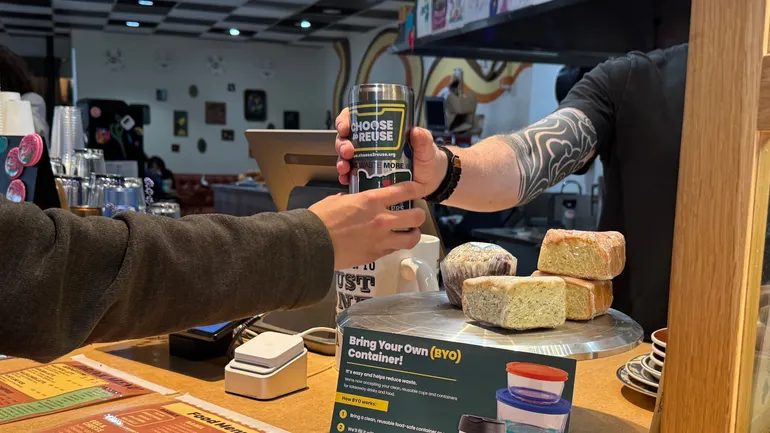
"Bring Your Own" is no longer just a habit of bringing drinks to parties or restaurants. A law in Oregon is driving the gradual popularization of the "bring your own container" concept—especially in the Portland metropolitan area, where local government has launched supporting reuse initiatives for food-related businesses.
In May 2023, Governor Tina Kotek signed a law allowing residents to bring their own reusable containers into food establishments, while separately signing a polystyrene foam ban. The Oregon Health Authority must establish rules by June 30, 2024, to make the bring-your-own-container provision take effect.
Metro is the regional government for the Portland metropolitan area, covering 24 cities across three counties, and is responsible for waste and recycling management in the region, including reusable packaging programs. Building on the state's voluntary bring-your-own-container law, the agency launched the regional "Choose to Reuse" awareness campaign, aimed at encouraging residents to bring their own reusable cups and containers when visiting food businesses, while also providing guidance to businesses on incorporating this practice into their daily operations.
"Many people here, if not most, care deeply about recycling, recycling rules, and how to do it right. We're trying to remind people that the third 'R'—reuse—should come first," said Gia Ballash, public affairs specialist at Metro. "Portland is an exciting place because people genuinely care about the environment, and I think we have a slight advantage in that regard."
Local residents are already somewhat familiar with reuse, thanks to years of groundwork by nonprofit organizations and private businesses, and the region is regarded as a pioneer in this practice. For example, local nonprofit Waste-Free Advocates led the formation of the Reusable Portland Coalition, whose steering committee also includes private companies Okapi Reusables and Revino.
Revino recently expanded its open-loop reusable wine bottle business to Washington State and California. The company also received $250,000 in state funding to expand its washing line in Oregon. With this expansion, Revino plans to provide washing and sanitizing services to producers of beer, kombucha, and various other beverages to support their reusable programs.

Under the Choose to Reuse program, Metro takes a more hands-on approach to supporting reuse. Dena Hastings, Metro's waste prevention program manager, explained that staff assist businesses with various aspects of the program, such as identifying single-use items suitable for replacement with reusable alternatives, and navigating the process of implementing their own bring-your-own-container programs. As part of the initiative, participating food businesses must develop a written plan and post signage, while also clearly understanding the types of containers customers may bring into their establishments.
On the outreach front, Metro has produced signage and stickers, and also developed informational business cards that residents can leave at local businesses where they wish to promote bring-your-own-container practices, to express their request.
"This campaign is still in a very early stage. It's still in the information dissemination phase, aimed at expanding reach and building brand recognition," Hastings said. "Without a consumer awareness campaign running in tandem with the Choose to Reuse business-side work, it would feel somewhat unbalanced. So we've put real effort into creating a consumer-facing page that runs parallel to the business-side page."
Other regional reuse initiatives
Metro's work also encompasses other reuse programs, involving not only food service ware but also a variety of other items.
The Metro Council passed the 20-year Regional System Facility Plan in March 2025, which clearly identifies the need for investment in reuse. The Reuse Impact Fund is the first project to be implemented under this plan, aimed at providing multi-year, flexible grants to nonprofit organizations to grow the Portland region's reuse economy. In November 2025, Metro awarded 16 organizations three-year grants ranging from $10,000 to $150,000 per year—with most of the funding directed toward product reuse programs beyond packaging.
Currently, Metro is partnering with Waste-Free Advocates on a pilot program that incentivizes businesses to adopt their own internal reusable food service ware solutions. Waste-Free Advocates manages the project, with Metro providing funding of up to $500 per business for three businesses, to cover the costs of replacing single-use items with reusable cups, containers, and utensils. The pilot program aims to gather lessons learned to inform the development of future formal programs.
Multi-party collaboration
Metro is tracking participation in the Choose to Reuse program and accepting feedback from all parties to drive program iteration. To date, Metro has found that the food truck segment is leading the way in adopting Choose to Reuse.
The regional government will also continue to apply lessons learned from researching reuse practices in places such as California, Seattle, and Toronto. Close collaboration with nonprofit organizations and private businesses is also a key component of successfully launching waste reduction programs.
"This isn't done alone. It's a big task and a collaborative effort," Hastings said.
Although "reuse is certainly a hot topic right now," she said, Metro prefers to take a steady, measured approach to implementing and expanding the Choose to Reuse program to ensure greater effectiveness.
"We don't want to rush things. I think we need to be mindful of who we're working with, what's happening right now, and build from there," Hastings said.