
2024 Packaging Industry M&A Trends: Mega-Deals Emerge, Impact of Inventory Correction Fades
As the impact of post-pandemic inventory correction diminishes, M&A activity in the packaging industry is expected to remain active but normalize in pace in 2024. Analysts note that recent cross-border mega-deals have been frequent, while small and mid-sized transactions remain the market's mainstay.
As the impact of post-pandemic inventory destocking fades, the key factors that once influenced packaging M&A decisions are gradually losing their influence. Analysts expect packaging M&A activity to continue in 2024, but at a more measured pace than the post-pandemic boom and the subsequent destocking trough.
Thomas Blaige, CEO of investment firm Blaige & Co., said during a webinar hosted by Alexander Watson Associates in June that packaging M&A activity has more than doubled over the past two decades and the sector is still expanding, though momentum has slowed in the last two years.
Damon Thome, managing director of private equity firm Mason Wells, noted at the same webinar that the deal pipeline over the past 12 months has been "not entirely strong, at least compared to the previous 12, 24, or 36 months."
But analysts point out that changes are brewing.
"In recent months, especially before summer, we've seen a clear uptick," said Evan Golden, a principal at private equity firm LongueVue Capital, during the webinar. "Many people are returning to the market, feeling more confident about their businesses and industry trends, and sensing that the foundation is solid."
Will Frame, CEO of Deloitte Corporate Finance, said in an interview that the pace and scale of packaging deals so far in 2024 have been "relatively moderate," a trend that could last into the third quarter. "My best guess is that after that, we'll see a return to normalcy, meaning solid and meaningful deal volume... I expect that trend to continue into the second half of this year and beyond."
Destocking, sustainability, and private equity
Over the past year, post-pandemic supply chain conditions, especially destocking, have had a significant impact on the slowdown in M&A activity. Across various packaging substrates, companies have felt the impact of customers working through inventories built up early in the pandemic. Industry observers widely expected a correction, but its magnitude far exceeded expectations.
"I think the magnitude of the correction surprised almost everyone in the market," Frame said. "And the duration... most people expected a 30- or 60-day event, but it ended up lasting four to six months for most."
The impact of destocking on customers translated into lower sales and revenue for packaging companies, which in turn affected their M&A prospects and timing: companies considering a deal don't want weak financial results from the last quarter or two.
"Most people are waiting for that impact to fall out of the 12-month lookback window... and then sellers might consider pulling the trigger to start the M&A process," Frame said.
Blaige said during the webinar that destocking also caused quality issues in the deal pipeline. Thome confirmed that some companies entered the market out of necessity rather than perfect timing.
Thome said the destocking in 2022 and 2023 "made it difficult for some companies to feel enough momentum to enter the market. That was certainly true for many private equity-backed platforms, but family-owned businesses were no exception. However, family-owned businesses have been and still are more willing to enter the market than private equity-backed platforms."
Frame noted that the private equity-led M&A boom that began roughly 18 to 24 months ago is a factor to consider when assessing deal potential over the next 6 to 12 months. Several specific areas, such as label converting and folding cartons, stand out.
"Many private equity firms acquired quality assets at high prices and took on higher debt leverage," Frame said. "At the same time, interest rates tripled. As the deal environment stabilizes this year, we'll see who emerges stronger and who may be in trouble."
Analysts say the current environment is creating conditions for certain opportunities—or preparing for upcoming ones—especially for fiber-based packaging companies.
"Because of the destocking issues the industry has faced... many companies with the ability to invest can strengthen their supply chains," said Jennifer Christ, research manager for consumer and commercial goods at The Freedonia Group. "It's a good time for paper packaging... There's huge underlying demand, and companies must be prepared to operate well in this industry."
The wave of brand packaging substrate conversion is also increasingly becoming a factor in M&A decisions. Frame said the industry previously pushed all substrates toward plastic (partly for safety and health reasons), but now the trend is exactly the opposite for sustainability reasons.
"Some customers make purchasing decisions based on their perception of packaging sustainability, and that's driving certain categories away from plastic," he said.
He explained that this trend "is fueling M&A within the consolidation cycle," noting that the cycle of consolidation, innovation, growth, and re-consolidation continues. Deloitte's Q1 2024 M&A report predicts that sustainability concerns will drive innovation throughout 2024, including growth in recycling and biodegradable PET.

Rise of cross-border deals
Although international M&A is nothing new, its visibility and importance have increased significantly in recent times.
"The cross-border element in today's M&A business is growing," Blaige said, explaining that about 73% of deals "have an international orientation."
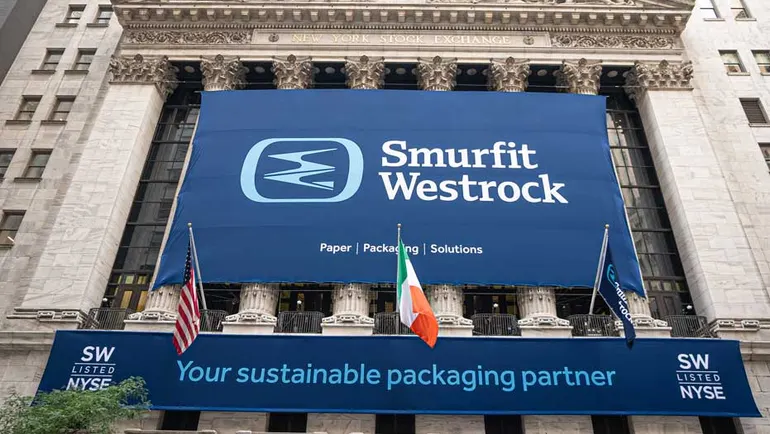
A series of high-profile international mega-deals among packaging giants began in September 2023, when Smurfit Kappa and WestRock announced they were in merger talks; that deal closed on July 5. In April, London-based DS Smith agreed to be acquired by International Paper after rejecting a takeover offer from Mondi. Weeks later, Brazilian pulp and paper company Suzano sought to acquire International Paper, but talks ended in June.
"Large companies can only do so much before hitting antitrust regulations... but there's really significant room for consolidation within the fiber packaging industry," said Christ of Freedonia.
Combining companies from different countries, especially when the geographic footprints of the portfolios differ significantly, is a strategic move for rapid growth, analysts say.
"'Scale' is the key word in rationalizing these deals," Frame said. "They're so large that it's almost impossible to drive growth in their domestic markets alone."
Before Sonoco's $3.9 billion deal to acquire Eviosys' metal packaging business (announced in June), recent international mega-deals were primarily among fiber companies. That's not just because fiber is the dominant packaging substrate.
"Think of industries like glass or metal cans—there's almost no room left for consolidation, and most of it is already international," Frame said. "I think those players generally haven't yet reached the scale and level of consolidation that would drive them to seek major international mergers."
So, after the deals completed in 2024, is the era of packaging mega-deals over? Analysts say that may be true in the short term, but anything is possible.
"In the U.S. market, International Paper and WestRock are the largest producers of corrugated board," said Mike Richardson, packaging analyst at The Freedonia Group, in an interview before the WestRock acquisition closed. "But Packaging Corporation of America and Georgia-Pacific are also significant. It's hard to say whether they have an interest in expanding their footprint in the U.S. market."
Still, analysts emphasize that packaging M&A overall is far from over.
"It never ends," Christ said. "There are clearly peaks and valleys. There's a constant underlying shift in capacity, and the ownership of these plants, distribution networks, and converting equipment is always changing."
Cluster effect

Analysts say that many M&A deals—especially mega-deals—seem to be announced in clusters, and that's not entirely coincidental.
"Sometimes these things do happen in succession," Christ said. "Acquisitions often trigger other acquisitions because competitors are looking for ways to keep up with major changes by key rivals. So if Smurfit Kappa is considering acquiring WestRock to expand in the U.S., it makes sense that International Paper and DS Smith would consider similar deals."
The overall trend is toward consolidation rather than divestiture, but sometimes divestitures also come in clusters. For example, Russia's invasion of Ukraine prompted many companies to divest their Russian assets, including Amcor, Ball, and International Paper.
But that doesn't mean divestitures are rare. Just this year, Ball completed its $5.6 billion sale of its aerospace business, becoming a pure-play packaging company; Berry announced the sale of two businesses in its international consumer packaging division and announced it would divest its Health, Hygiene & Specialties segment; Sonoco announced it would sell its protective solutions business, and other divisions may follow.
Small but significant
Not all recent M&A activity involves mega-deals. Analysts say the headline-grabbing large deals are not the mainstream, while smaller incremental deals accumulate to have a significant impact. "Frankly, deal volume comes from small and mid-sized transactions," said Deloitte's Frame.
According to data presented at the Alexander Watson Associates webinar, 82% of packaging companies have annual sales below $100 million. "So this is a small and mid-sized industry," Blaige said. "Over the past two decades, more than 80% of the largest, strongest packaging converters have been consolidated or sold," which increases the need for small and mid-sized companies to participate in deals.
Joe Iorillo, corporate research analyst at The Freedonia Group, said that over the past three years, there has been a surprising number of small M&A deals in the corrugated sector. For example, Atlanta-based Hood Container agreed this year to acquire Independent II and Sumter Packaging, following a series of acquisitions over the previous three years. In May, Wisconsin-based Green Bay Packaging acquired Missouri-based SMC Packaging Group.
Similarly, Indiana-based Welch Packaging has been acquiring smaller box makers, Iorillo noted, including last year's acquisitions of Tennessee-based Nashville Box and AtCorr Packaging, and last month's acquisition of Northeast Box. "They're intentionally increasing their corrugated capacity and expanding into different regions of the U.S.," Iorillo said.
Additionally, Mason Wells' Thome said smaller companies may be better positioned for M&A deals in the coming months, as many posted better first-quarter sales results than larger public companies. Still, as economic headwinds gradually fade, deal volume involving smaller players will pick up in 2024. "That's an important part of returning to normalcy," Frame said.
As the packaging industry returns to normal in mid-2024 and beyond, industry observers are looking ahead to deal potential in 2025.
"I don't think there will be a major shift in the packaging M&A community in 2024," Thome said. Companies are more likely to wait for demand to recover, build up some growth, and then "use that as a foundation when considering bringing their businesses to market in 2025."