
Plastic regulations tighten, companies accelerate bets on paper packaging innovation
Regulatory requirements and consumer demand are pushing more companies to switch packaging materials from plastic to paper, with applications ranging from cushioning pellets to beverage bottles. However, some groups question whether paper is truly superior and to what extent it helps companies fulfill their sustainability commitments.
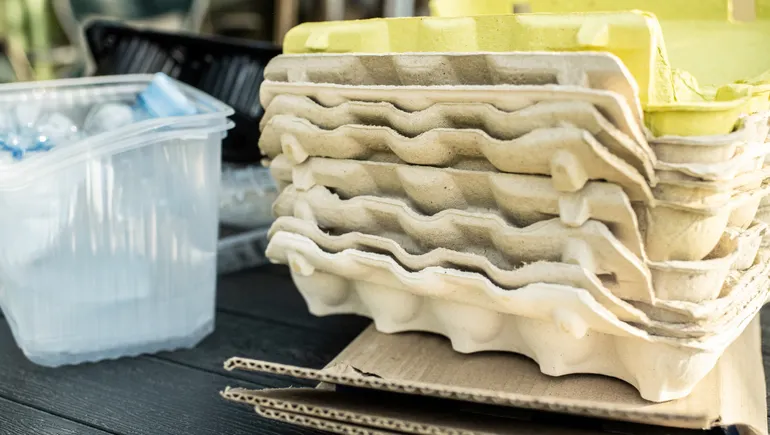
Regulatory requirements and consumer demand are driving more companies to shift packaging materials from plastic to paper, with applications ranging from cushioning pellets to beverage bottles. However, some groups question whether paper is truly superior and to what extent it helps companies fulfill their sustainability commitments.
The growing evidence of plastic's potential negative impacts on the environment andpublic healthis receiving increasing attention. For example, data from the United Nations Environment Programme shows that about 98% of single-use plastic products are made from fossil fuel feedstocks, and greenhouse gas emissions from the production, use, and disposal of these plastics are expected to rise to 19% of the global carbon budget by 2040.
In response to these growing concerns, regulators at various levels of government have introduced new policies.
Negotiations aimed at creating the world's first plastics treaty ended in December last yearwithout an agreementbut will continue this year. The European Union also recently passed a stricter newpackaging waste regulationcovering all types of packaging, including certain single-use plastics. The U.S. Environmental Protection Agency recently adopted a non-bindingstrategy to prevent plastic pollutionandmultiple statesare implementing extended producer responsibility laws for packaging.
Given these policy changes, many brands are seeking plastic alternatives from their packaging suppliers. This in turn is driving packaging manufacturers to increase innovation in fiber materials.
The market continues to expand
The industry expects that demand for fiber as a plastic alternative will grow significantly across the packaging industry in the coming years. For example, Freedonia Groupforecaststhat the molded fiber market will rise to over $4 billion by 2030, up from about $1 billion in 2015.
To date, many efforts to shift to paper have focused on shipping and food packaging. For example, Amazon recentlyreplaced99.7% of its mixed-material bubble mailers with recyclable paper mailers; JDE Peet's announced plans to usepaper bagsto package its coffee; Nissin Foods USA's Cup Noodles now usespaper cupscontaining 40% recycled paper for packaging.
DS Smith is a company that has made fiber-based packaging its core business rather than an experiment.International Paper is acquiring the company. Marc Chiron, Director of Sales, Marketing, and Innovation for DS Smith's packaging division, said in an email that the company divested its plastics business in 2021 and is now a fully fiber-based company.
As part of its sustainability strategy, the company achieved its goal of replacing 1 billion plastic items by 2025 ahead of schedule: as of May 2024, it had replaced 1.2 billion items. This goal was achieved through collaboration with the Ellen MacArthur Foundation to design new solutions for fiber-based packaging across multiple sectors, including food and beverage, automotive parts, and retail goods.
Chiron said: "(By) carefully examining factors such as recycled content percentage, recyclability, estimated CO2 emissions, and excess waste levels to advance each project, we have helped strengthen the company's overall sustainability mindset and cultural focus."
He added that the first carton the company produced using these metrics was a beer container launched in 2021 for UK-based Toast Ale. DS Smith also helped Bosch Home Comfort Group switch to fully recyclable packaging for its gas boilers, saving 100,000 plastic components annually and reducing CO2 emissions by 310 tons.
Chiron said that even small design changes like replacing plastic labels can make a significant difference. "Our mission is to design out waste and reduce plastic in various formats."

The pursuit of the perfect paper bottle
Some of the most ambitious efforts to develop paper alternatives are emerging in the beverage industry. Several companies, including Coca-Cola, PepsiCo, Procter & Gamble, and Diageo, are developing paper bottles.
Many in the industry say one challenge in developing paper alternatives is ensuring that beverages are properly sealed while also ensuring the bottle can be fully recycled.
Ron Khan, Vice President of Beverage Packaging at PepsiCo, said: "Paper and liquid—you know, those two don't seem to go well together."
PepsiCo is working with Pulpex to develop a molded fiber bottle to challenge that assumption. Its prototype is made from a wood pulp mixture that is mixed, molded, and then dried—a proprietary process that prevents leakage and ensures durability and recyclability. The wood pulp comes from forests certified by the Forest Stewardship Council and recognized by the Programme for the Endorsement of Forest Certification.
In the pursuit of a 100% recyclable paper bottle, one of the biggest obstacles is finding the right material to create a sufficient barrier between the liquid and the paper.
This barrier must meet multiple, sometimes competing criteria, including effectiveness, food safety, lightweighting, and recyclability. For example, a barrier might meet food safety requirements but be too thick.
Many prototypes contain plastic liners that must be manually separated before the bottle can be placed in paper recycling bins. But according to the company, the latest generation of Pulpex fiber bottles is designed to be recycled like other paper materials.
Khan said: "The biggest challenge has always been the coating, and we are in the final stages." According to the company, this water-based, food-grade coating blocks moisture and oxygen.
Khan added that finding a viable paper bottle is part of PepsiCo's broader sustainability goals. The "Pep+" initiative launched by the company in 2021 aims to integrate sustainability into its entire operations, from production to distribution, as shown in its latestESG report(released in 2024).
Few paper bottles have advanced beyond the prototype stage, but the wood fiber bottle developed by Carlsberg in partnership with Denmark's Paper Bottle Co. (better known as Paboco) is an exception. Its paper-packaged beer has been tested in stores in the UK and Sweden. The bottle's barrier is made from PEF (polyethylene furanoate), a plant-based polymer that, according to the company, maintains the beer's foam and flavor. While the PEF liner is biodegradable, in many regions it must be separated and recycled as plastic.
Paboco CEO Tim Silbermann said consumer response has been positive so far, with users praising the bottle's look and feel, although some complained it still contains plastic.
The company, which also works with Coca-Cola and L'Oréal, has replaced the plastic neck in its initial prototypes with a paper neck and continues to work on creating a non-plastic barrier.
Silbermann said: "We have always been very transparent about the stages of this process. This is the first generation, and we want to try and see how it works."
Finding ingredients that meet paper recycling regulatory requirements across Europe is also a challenge. For example, regulations in Germany require packaging to contain 95% paper to be considered recyclable paper.
He said: "Recyclability is a complex topic, especially in Europe, because there are many markets with different regulations." The EU's new packaging rules, formally adopted by the European Council last month and expected to be implemented next year, aim to help address this fragmentation.
Carlos Diaz Acosta, a packaging-focused engineer at the Rochester Institute of Technology, said that despite the many challenges of producing durable, fully recyclable bottles with sustainably sourced wood fiber, the technology shows promise.
He said: "It's evolving. I don't know if I'd say it's evolving quickly, but they keep making it better. We don't know if we'll see it on shelves next year or in five years."
Paboco, which uses FSC-certified wood fiber, is expanding. Silbermann said the company plans to move to another location in Denmark this year and install larger machines to increase production capacity.

Paper is not perfect
Complicating the shift from plastic to paper is the fact that fiber itself brings a set of environmental issues. While the material is touted as a renewable resource and its circularity is widely considered superior to plastic packaging, its environmental impact cannot be ignored.
Diaz-Acosta said: "Paper gives the impression that its source is renewable—which is (still) to be defined. What does renewable mean?"
According to the nonprofit Canopy, about 3 billion trees are cut down each year to make paper packaging. The organization works with packaging companies to reduce their environmental impact.
Mariah De Los Santos, communications specialist for the organization, wrote in arecent post on its website: "One of the most common misconceptions is that logging for paper packaging is a solution to plastic pollution. But this approach is trading one environmental disaster for another. In the face of the climate and biodiversity crises, protecting forest ecosystems is crucial."
The EU has adopted a newdeforestation regulationrequiring companies selling or exporting commodities such as wood, beef, cocoa, and palm oil—typically produced on cleared forest land—to the EU market to prove that their products do not come from recently deforested areas or contribute to forest degradation. The regulation will be phased in over the next two years.
Pulpex and Paboco say they are addressing deforestation concerns by using only certified wood to make their paper bottles. For example,FSC-certified woodis harvested in ways that largely avoid clear-cutting, instead using selective logging and maintaining wide buffer zones along salmon-bearing streams, among other practices.
Because paper can be repulped, it is easier to recycle than plastic—which requires more chemicals to break down due to its durability. But paper cannot be recycled indefinitely; its fibers shorten with each cycle, averaging only about six cycles, according to U.S. EPA data.
Paper production also requires significant energy. According to a2011 analysisconducted for the Northern Ireland Assembly, making a paper bag requires four times more energy than making a plastic bag. And because paper is heavier than plastic, transporting paper may require more fuel, increasing its carbon footprint.
Some critics argue that instead of shifting to paper and other alternative materials, companies should focus on reducing plastic production. In their view, simply replacing plastic with paper does little to address the single-use problem.
A 2023reportby the advocacy group European Environmental Bureau called the shift to paper a "false solution" to the plastic packaging problem. The report accused McDonald's and other large food companies of "greenwashing" by marketing single-use paper containers as a sustainable option. The group encourages reducing the use of both plastic and paper single-use packaging.
But company representatives point out that by shifting to paper and other materials, they are reducing demand for virgin plastic.
For example, PepsiCo has set a goal toreduce virgin plastic from non-renewable sources by 20%across all packaging categories by 2030. It also set a goal to design 100% of its packaging to be recyclable, compostable, biodegradable, or reusable by 2025. Itslatest ESG reportprojects it will reach 98% by 2025.
For Khan, PepsiCo's paper bottle with Pulpex demonstrates what can be achieved in beverage packaging through innovation and modern technology.
He said: "I've worked in the packaging industry for 33 years, and all the packaging work I've done has been about modifying packaging, whether it's glass, bottles, or PET. This is the first time we're truly developing a completely new form of packaging. So it's exciting."
But he added that paper bottles will take time to perfect. "We were one of the pioneers of PET bottles 40 years ago. It took us 40 years to optimize the bottle. We are now starting that journey with paper."
Correction:This article has been updated to reflect PepsiCo's latest virgin plastic reduction target and its projected progress toward its goal of making all packaging recyclable, compostable, biodegradable, or reusable.